
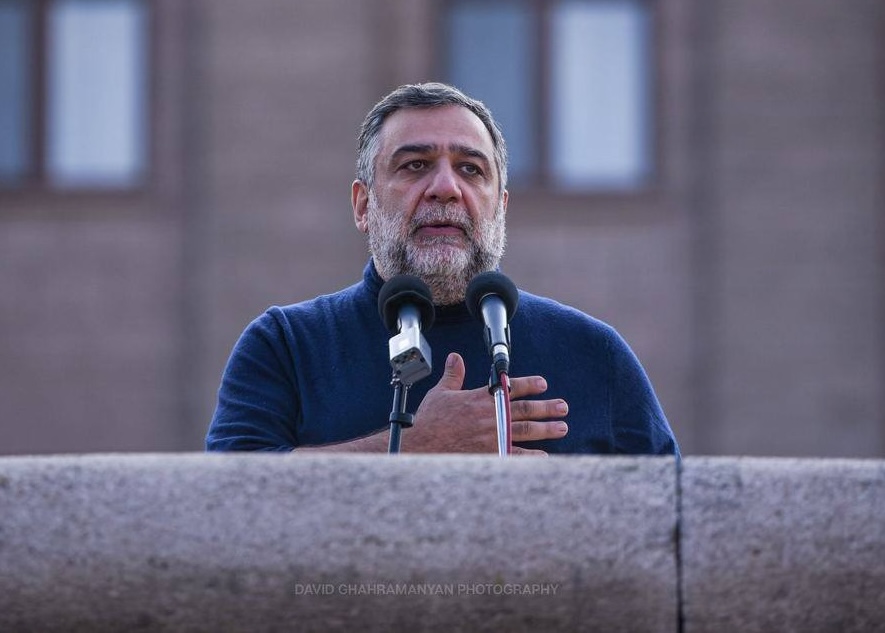

On December 18, an Azerbaijani state prosecutor formally motioned for a life sentence against Armenian humanitarian, philanthropist, and former Artsakh (Nagorno-Karabakh) State Minister Ruben Vardanyan during the latest hearing in his case at the Baku Military Court, as part of an ongoing sham trial. As he faces the prospect of life imprisonment in Azerbaijan, Vardanyan has remained defiant, rejecting the legitimacy of the proceedings and preparing to directly address the court in what he has described as an imitation of justice. He is being held illegally in Baku, Azerbaijan, where the proceedings have raised widespread concerns over their legitimacy.
On December 17, during a phone conversation with his eldest son, David, Ruben Vardanyan said he expects to be given the opportunity to deliver his final statement to the court in the near future, his family reported.
Ruben Vardanyan Declares “I Regret Nothing” in Phone Call With Son
In his expected final statement, Vardanyan intends to emphasize the following:
“I do not recognize what is happening as a judicial process and do not intend to participate in an imitation of justice. The proceedings taking place in Baku do not meet the basic standards of a fair trial and therefore cannot be regarded as a court in the true sense of the word.
I regret nothing. All my actions were taken consciously and voluntarily, fully understanding the possible consequences. I am ready to answer for my actions before God. The only thing I regret is that I was not able to do more.
Once again, I declare: Artsakh was, is, and will be, regardless of attempts to rewrite history or impose an alternative interpretation of events.”
Vardanyan also wished to share the following thoughts and to thank everyone who continues to support him:
“One should not fear death or try to ‘defeat’ it. It is not death that is frightening. What is truly frightening is indifference, a state that enters us quietly and gradually, like radiation, and destroys us from within.
One should not be afraid to follow one’s own path: to search, to make mistakes, and to explore the world throughout life. The most important thing is to walk one’s path consciously.
What matters most is not to cause harm, not to destroy the delicate balance that exists in nature and in the world. We are all particles of a vast shared space that can exist only in harmony.
Cherish your words. A word can wound deeply, but it can also give a powerful impulse for growth, support, and creation.
I am grateful that I can serve my people. I thank all those who have stood by me, and continue to stand by me, during this difficult period.”
The hearing was closed to independent observers, with attendance limited exclusively to Azerbaijani state media and outlets controlled by the authorities. As a result, it remains impossible to independently verify statements attributed to the Armenian defendants or other details of the proceedings through alternative or international sources.
Background on Arrest and Charges
Vardanyan, who served as Artsakh’s State Minister from November 2022 to February 2023 and held the second-highest position in Artsakh’s leadership, was arrested at an Azerbaijani checkpoint in the Lachin corridor during the mass exodus of Armenians from Artsakh in September 2023. He was detained while attempting to return to Armenia alongside the civilian population fleeing the region.
He stands accused under multiple articles of Azerbaijan’s Criminal Code, including alleged “crimes against peace and humanity,” “war crimes,” “terrorism,” “financing terrorism,” “illegal entry into Artsakh,” and “supplying military equipment” to its armed forces. He faces 42 charges, several of which carry the possibility of life imprisonment.
Vardanyan’s case has been separated from those of other military and political leaders of Artsakh who are also being held illegally in Baku and is being examined under a separate legal proceeding.
Allegations of Due Process Violations
Ahead of the first hearing in his case on January 16, Vardanyan conveyed a message to his family via a phone call, stating that he had not been given the opportunity to properly familiarize himself with the official indictment. He said he was only allowed to briefly leaf through the 422-volume criminal case file in Azerbaijani, a language he does not speak, and was given extremely limited time to do so.
Vardanyan also stated that pressure had been exerted on him, his lawyer, and his interpreter to force them to sign documents retroactively, including falsified interrogation records for questioning sessions that never took place. He has demanded an open and public “trial.”
Other Artsakh Leaders and Legal Context
Earlier, Siranush Sahakyan, president of the International and Comparative Law Center, stated that Azerbaijani prosecutors have sought life sentences for nearly all former Artsakh leaders currently on “trial,” with the exception of former presidents Arkadi Ghukasyan and Bako Sahakyan.
According to Sahakyan, Azerbaijani legislation classifies defendants over the age of 65 as elderly, legally prohibiting the imposition of life imprisonment. She noted that prosecutors themselves acknowledged this during the proceedings, stating that they were therefore seeking the harshest possible alternative punishment of 20 years in prison in those cases.
Criticism of Armenian Government and Peace Talks
The Armenian government has faced criticism for allegedly doing little to secure the release of these individuals, along with 15 other Armenian prisoners currently held in Azerbaijan. The government has denied these claims, which were also voiced earlier this year by Vardanyan’s American lawyer, Jared Genser.
In a June interview with RFE/RL’s Armenian Service, Genser noted that a draft Armenian-Azerbaijan peace treaty finalized in March does not address the fate of the prisoners. Instead, it focuses on a mutual commitment by both sides to withdraw the international lawsuits they have filed against each other.


