
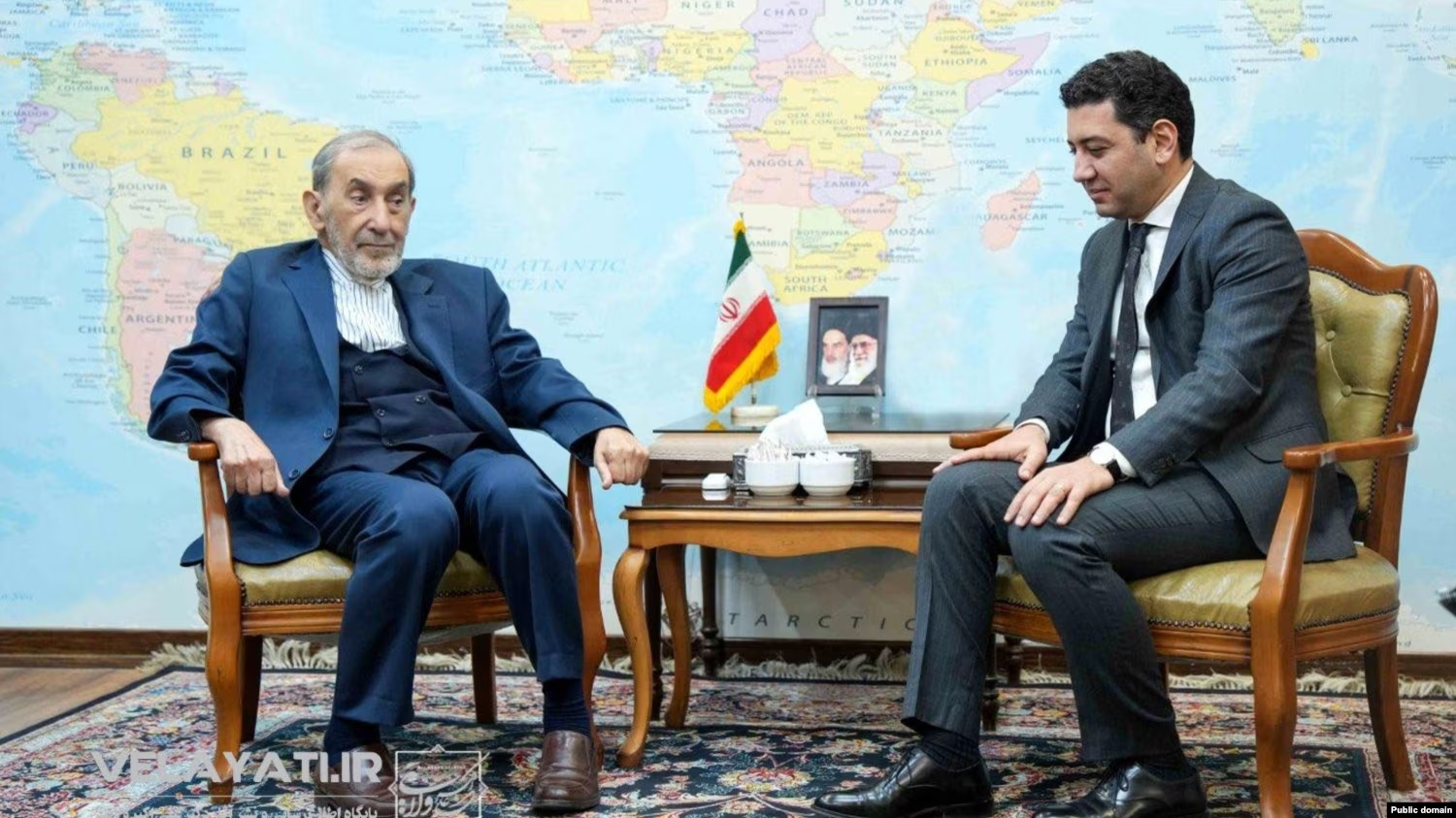

Iran’s senior adviser to the Supreme Leader has declared full opposition to the Trump Route for International Peace and Prosperity (TRIPP), with Ali Akbar Velayati claiming the project mirrors the so-called “Zangezur Corridor” and poses security risks, including the potential for US or NATO presence near Iran’s borders. Armenian officials have categorically rejected these claims, stressing that TRIPP is a civilian infrastructure and business initiative that will operate entirely under Armenia’s sovereignty, territorial integrity, and jurisdiction, with no security or extraterritorial component.
Iranian Objections and Security Claims
Ali Akbar Velayati, senior adviser to Iran’s Supreme Leader on international affairs, made the remarks during a meeting with Armenia’s ambassador to Iran, Grigor Hakobyan, on December 14, according to Iran’s state news agency IRNA.
According to the Iranian side’s report, Velayati stated that the so-called Trump plan for the Caucasus is practically the same as the “Zangezur Corridor” project, but under a different name, and that Iran is therefore categorically opposed to it. He said Tehran has opposed the Zangezur corridor from the outset, as it rejects any changes to regional borders and views such projects as threats to its surrounding security environment.
Velayati warned that the project poses a serious threat to the security of northern Iran and could create conditions for NATO or US military presence north of the country, which he said would also create serious security risks for southern Russia. He further claimed that the plan is now being pursued through the entry of American companies into Armenia.
He also stated that historical experience shows a recurring pattern in which the United States enters sensitive regions under the pretext of economic initiatives, only for its presence to later expand into military and intelligence dimensions. Velayati warned that the opening of US presence at Iran’s borders in any form would have clear security consequences for the Islamic Republic.
In separate remarks reported by Iranian and regional media, Velayati claimed that Iran would prevent the opening of what he described as an “American corridor” through Armenia “with or without Russia.”
Some outlets characterized these statements as Iran warning Armenia against opening a US-administered transit corridor for Azerbaijan. Armenian officials have rejected this characterization.
Armenia’s Diplomatic Response in Tehran
During the December meeting, Armenian Ambassador Grigor Hakobyan described Armenia–Iran relations as strategic and said strengthening ties with Tehran remains one of the key priorities of Yerevan’s foreign policy.
According to a statement released by the Armenian embassy in Iran, Hakobyan informed Velayati that the “TRIPP Route” will be implemented based on the principles of territorial integrity, sovereignty, legality, and reciprocity of the countries involved, and will create broad opportunities for regional connectivity and economic development.
The statement added that the Republic of Armenia’s ambassador reaffirmed that Yerevan highly values Tehran’s unequivocal respect for these principles and, in turn, takes into account the security and political sensitivities of friendly Iran.
The embassy also noted that both sides emphasized the historical and strategic nature of Armenia–Iran relations and expressed a mutual willingness to deepen cooperation. According to reports, the meeting included Velayati welcoming efforts aimed at normalizing relations between Armenia and Azerbaijan and promoting regional stability.
Armenia Rules Out NATO or Security Component
Responding to the statements from Tehran, Chairman of the National Assembly Standing Committee on Foreign Relations Sarkis Khandanyan said that a NATO presence in Armenia is impossible, as the country has no aspirations for NATO membership.
“Armenia maintains a specific framework for cooperation with NATO, which does not include the physical presence of the North Atlantic Alliance on its territory. Discussing this issue in the context of the TRIPP project is inappropriate,” Khandanyan said at a press briefing on Tuesday.
He also stressed that TRIPP is not a security initiative. “TRIPP remains, as it has been, an infrastructure project and, in some respects, a business project. It is a bilateral Armenian–American initiative. There is no security component in this project; its purpose is to develop infrastructure in Armenia, including within the context of regional unblocking,” he said.
Rubinyan Rejects ‘Zangezur Corridor’ Narrative
Vice Speaker of the National Assembly Ruben Rubinyan rejected claims equating TRIPP with the so-called “Zangezur corridor,” noting that such narratives, promoted by Azerbaijan and Turkey, imply extraterritoriality, which Armenia has categorically ruled out.
“Our ambassador has reiterated to the Iranian side that TRIPP is a business project that will operate fully under Armenia’s sovereignty, territorial integrity, and jurisdiction, and on the principles of equality and reciprocity. No, TRIPP is not the same as the so-called ‘Zangezur corridor,’” Rubinyan said.
Rubinyan added that Armenia remains in constant contact with Iranian partners, keeps them informed about developments, takes their sensitivities into account, and duly considers their interests. He highlighted that Iran’s Ministry of Foreign Affairs, including the foreign minister, has repeatedly stated that the project respects Iran’s red lines and creates opportunities for the country.
Addressing continued statements from individual Iranian officials, Rubinyan said that any country’s official position is expressed by its foreign ministry and that Armenia relies on the statements of Iran’s Ministry of Foreign Affairs.
“It is out of the question that there could be any project in Armenia that would contradict Armenia’s sovereignty and territorial integrity or that would not be under Armenia’s full jurisdiction. Above all, this is Armenia’s red line: there will be no extraterritorial corridor through Armenia,” he said.
MFA Position
Armenia’s Foreign Ministry (MFA) did not comment directly on Velayati’s statement. MFA spokesperson Ani Badalyan told News.am that the MFA position on the matter is well known. “The Armenian embassy has issued a statement regarding the meeting; please be guided by it.”
TRIPP Framework and White House Summit
The Trump Route for International Peace and Prosperity was agreed upon by the leaders of Armenia, the United States, and Azerbaijan and was formalized in a trilateral declaration signed at the White House in Washington on August 8, during a summit hosted by US President Donald Trump that included Armenian Prime Minister Nikol Pashinyan and Azerbaijani President Ilham Aliyev.
The project is a connectivity initiative envisaged under the US-brokered Armenian-Azerbaijani declaration and is part of Armenia’s Crossroads of Peace project. The route is expected to connect Azerbaijan to its Nakhichevan exclave through Armenia, including via Armenia’s southern Syunik province, which borders Iran.
Prime Minister Nikol Pashinyan has stated that the Armenian-American joint venture TRIPP Company will implement the project. The company will be registered in Armenia and will be responsible for developing railway and road infrastructure, as well as oil and gas pipelines and fiber-optic cables. According to Pashinyan, the implementation and construction phase is expected to begin as early as 2026.
US Ambassador Outlines TRIPP Vision
A day earlier, US Ambassador to Armenia Kristina Kvien commented on the project in an interview with CivilNet. She said the initiative is envisioned to be developed jointly with the United States through a new enterprise currently in the process of being established, with Armenia maintaining a permanent seat at the negotiating table.
Kvien said the creation of a safe and secure transit route running north–south and east–west, through Nakhichevan, Armenia’s Gyumri, and Turkey’s Kars Province, would link the East and the West and benefit countries along its path, with Armenia expected to be among the primary beneficiaries. She added that TRIPP aims to connect Central Asia with Western Europe by overcoming long-standing geopolitical obstacles in the South Caucasus and noted that Turkey’s developed railway network would facilitate the route’s operation beyond Kars.
Criticism and Additional Regional Context
Some opposition figures in Armenia have claimed that TRIPP effectively meets Azerbaijan’s demands for unfettered transit to Nakhichevan, a characterization echoed by Azerbaijani officials. The Armenian government has rejected these claims, reiterating that all transit routes will remain under Armenia’s full sovereignty and jurisdiction.
In late September, Iran’s outgoing ambassador to Armenia, Mehdi Sobhani, also commented on the project, signaling Tehran’s continued concerns and citing what he described as a lack of specifics in public Armenian statements regarding the arrangement.
US Engagement and Military Context
TRIPP was reportedly discussed during a visit to Yerevan by US Under Secretary of State Allison Hooker.
Additionally, Brigadier General Chris McKinney, a deputy director at the US military’s European Command (EUCOM), visited Armenia earlier this month. According to a December 10 statement by the US Embassy in Armenia, the visit aimed to “support the outcomes of the August 8 White House Peace Summit.”
The embassy said EUCOM is working with Armenia’s Ministry of Internal Affairs and Ministry of Defense to advance shared objectives in support of sustained peace, including enhanced cooperation on Chemical, Biological, Radiological, and Nuclear (CBRN) defense and continued military modernization efforts. The statement did not specify whether these activities are connected to the TRIPP project.


