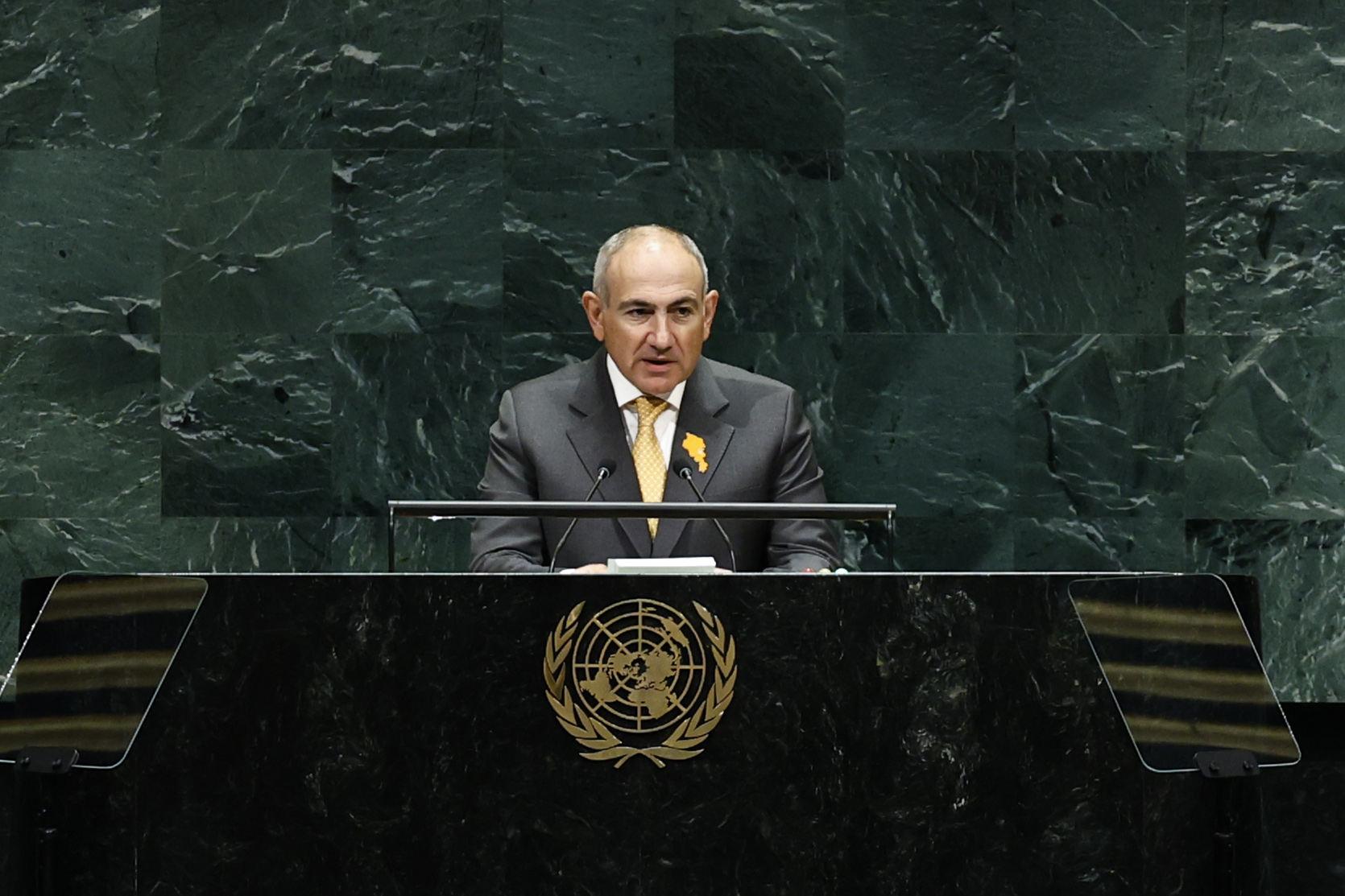

Prime Minister Nikol Pashinyan told the 81st session of the UN General Assembly on Wednesday that the peace between Armenia and Azerbaijan, established on August 8, 2025 at the Washington summit, would not have been possible without US President Donald Trump.
“The breakthrough in the establishment of peace between Armenia and Azerbaijan simply would not have been possible without President Trump’s personal engagement and his resolute commitment to establishing peace,” Pashinyan said, responding to remarks Trump had made from the same podium two days earlier.
He said the full peace agreement initialed at Washington still needs to be signed and ratified, and that completing it is the next major item on the joint agenda with Azerbaijan.
On unresolved humanitarian matters, Pashinyan said Armenia and Azerbaijan have agreed to cooperate on clarifying the fate of several thousand missing persons and will continue working together on demining. On the Armenian hostages held in Azerbaijan, he said, “People in the Republic of Armenia are waiting for the return of Armenians who were detained in Azerbaijan as a consequence of the conflict.”
The 19 Armenians held in Baku are hostages seized during Azerbaijan’s September 2023 assault on occupied Artsakh, and they include the entire former political and military leadership of the Republic of Artsakh. On February 5, 2026, a Baku Military Court sentenced former president Arayik Harutyunyan, along with David Babayan, Davit Ishkhanyan, Levon Mnatsakanyan, and Davit Manukyan, to life imprisonment, and former presidents Arkadi Ghukasyan and Bako Sahakyan to 20 years. Former State Minister Ruben Vardanyan was tried separately and sentenced to 20 years on February 17, 2026. Amnesty International called the verdicts “a travesty and a mockery of justice.”
Pashinyan also argued that both governments should set aside conflict rhetoric, including over history and historical-cultural monuments, in favor of the peace process, and noted that two and a half years have passed without cross-fire casualties, which he called the greatest value created in recent years.
Much of the address covered the Trump Route for International Peace and Prosperity, or TRIPP, the transit route across Armenian territory set out in the Washington declaration. Pashinyan said the framework agreement with the United States will soon be ratified by Armenia’s National Assembly, and that a development company is being formed in which Armenia will hold a 26 percent stake and the United States 74 percent. Armenia’s share rises to 49 percent in the 50th year, he said, without additional investment.
He described the route as historic for Armenia. It will give the country its first railway link to Azerbaijan since the early 1990s and restore a rail connection between the Persian Gulf and the Black Sea. Alongside a future Armenia-Turkey railway, Pashinyan said, TRIPP would open a new route linking China, Central Asia, Turkey and the European Union. He noted that Azerbaijan had already opened its railway to Armenia through Georgia after the summit, and that Armenia will rebuild the Soviet-era Meghri and Yeraskh rail sections that were later destroyed.
The route includes what the peace declaration calls unimpeded connectivity between the main part of Azerbaijan and its Nakhichevan exclave through Armenian territory. Pashinyan said this would operate on the basis of respect for Armenia’s sovereignty, territorial integrity, and jurisdiction. He said the framework also opens the way to building pipelines, power lines, and roads, and could make the South Caucasus what he called a “Crossroads of Peace.”
Turning to foreign policy, Pashinyan said Armenia has built strategic partnerships in recent years with Georgia, France, China, the Netherlands, Kazakhstan, Germany, Luxembourg, the United Kingdom, Bulgaria, Croatia, Lithuania, the United States, and the European Union. He said the European Commission had approved autonomous trade measures for Armenia that day. He described relations with Russia as “in a transformation phase,” a shift he tied to the end of the Armenia-Azerbaijan conflict, and said Armenia is “resolutely” advancing normalization with Turkey, endorsing words Erdogan had spoken from the same podium days earlier. He said relations with Iran and Georgia remain of exceptional importance.
Pashinyan closed by inviting delegates to the UN biodiversity conference, COP17, which Armenia hosts in October.