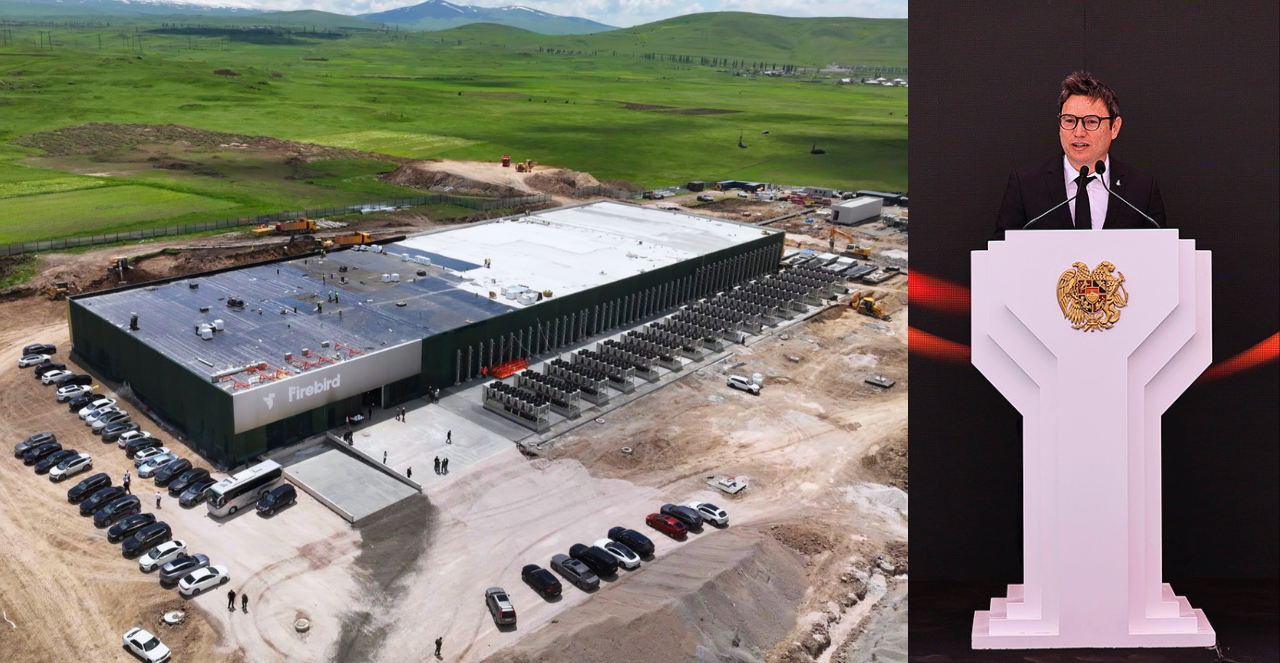

The Wall Street Journal reported this week that U.S. negotiators used access to NVIDIA’s advanced AI chips as part of a broader package of economic incentives surrounding the peace process. The report highlighted Firebird’s AI infrastructure investment in Armenia and the export licenses that made access to the advanced chips possible.
In a statement to Zartonk, Firebird Co-Founder and CEO Razmig Hovaghimian offered additional context on the origins, timeline, and broader economic mission of the project, saying Firebird’s work in Armenia has roots going back years and is part of a much longer effort to connect Armenia more deeply to the global technology economy.
“Firebird and our Armenia project were established independently of the diplomatic developments described in the article. Our roots go back years, including Jensen Huang’s visit to Armenia in 2023,” Hovaghimian said. “Our work is part of a much longer effort to connect Armenia and other frontier markets more deeply to the global economy.”
He pointed to Firebird’s original launch and the timeline of the project. “We announced Firebird’s launch and our initial $500 million AI infrastructure project in Armenia with the Armenian government and support from NVIDIA in Paris in June 2025,” he said. Hovaghimian credited the governments on both sides. “The Armenian and U.S. governments have been incredibly supportive of our vision and growth plans in Armenia,” he said.
The Wall Street Journal reported that expanded chip approvals later became part of the broader economic relationship surrounding the peace negotiations, an example of what U.S. officials call “chip diplomacy.” According to the Journal, Firebird had initially applied for an export license for around 6,000 GPUs, with U.S. officials subsequently approving tens of thousands of additional NVIDIA processors as the project expanded. The Journal described technology access and economic cooperation as part of a wider U.S. effort to deepen economic ties with Armenia and Azerbaijan alongside the peace process.
Hovaghimian said peace and greater regional stability can help accelerate the kind of investment Firebird is making, while emphasizing that the company’s mission in Armenia is much broader and long term.
“Firebird 1 in Armenia is ultimately about Armenia’s economic future and its ability to directly help shape the next generation of the global technology economy,” Hovaghimian said. “Peace and regional stability create the conditions for investment, innovation, growth and global partnerships to thrive. We are a U.S. based company, and we created Firebird with a broader mission for Armenia: to help make the country economically stronger and grow it into a global technological powerhouse. And we have said it from the beginning and we mean it: From Armenia to the world. AI can be a great equalizer for world economies, and a platform to create opportunities for all.”
Firebird has since announced expansion into other frontier markets, including Kazakhstan, with additional markets expected to follow. The company’s model is centered on building large-scale, U.S.-standard AI infrastructure and a cloud layer, while making advanced computing capacity available to local companies, startups, universities and researchers. Hovaghimian said Firebird reserves up to 20 percent of capacity in each market to help develop the local technology sector, and will invest in local robotics, aerospace, and life sciences companies through Firebird Labs starting in 2027.
In Armenia, part of the factory’s capacity is intended to support the country’s own technology ecosystem. Under an agreement with the Ministry of High-Tech Industry, the Armenian government is acquiring $25 million in computing resources from Firebird over five years, expected to be made available to local startups, universities, research centers, and government-supported programs.
The WSJ report quoted several U.S. figures on the role of the chips. Former U.S. Ambassador to Armenia Kristina Kvien said diplomats promoted technology access as a way to reach a deal, calling the NVIDIA piece an important part of the puzzle. Senator Steve Daines, a Montana Republican, said Firebird was the most tangible proof Pashinyan could point to that peace delivered results. Pashinyan’s spokesperson, Melania Harutyunyan, described the Washington agreements, including the memorandum on semiconductors and artificial intelligence, as important peace dividends for Armenia. NVIDIA’s Rev Lebaredian, who helped build the company’s ties with Armenia, said cooperation on AI and the trade corridor could create economic interdependence in the region.